
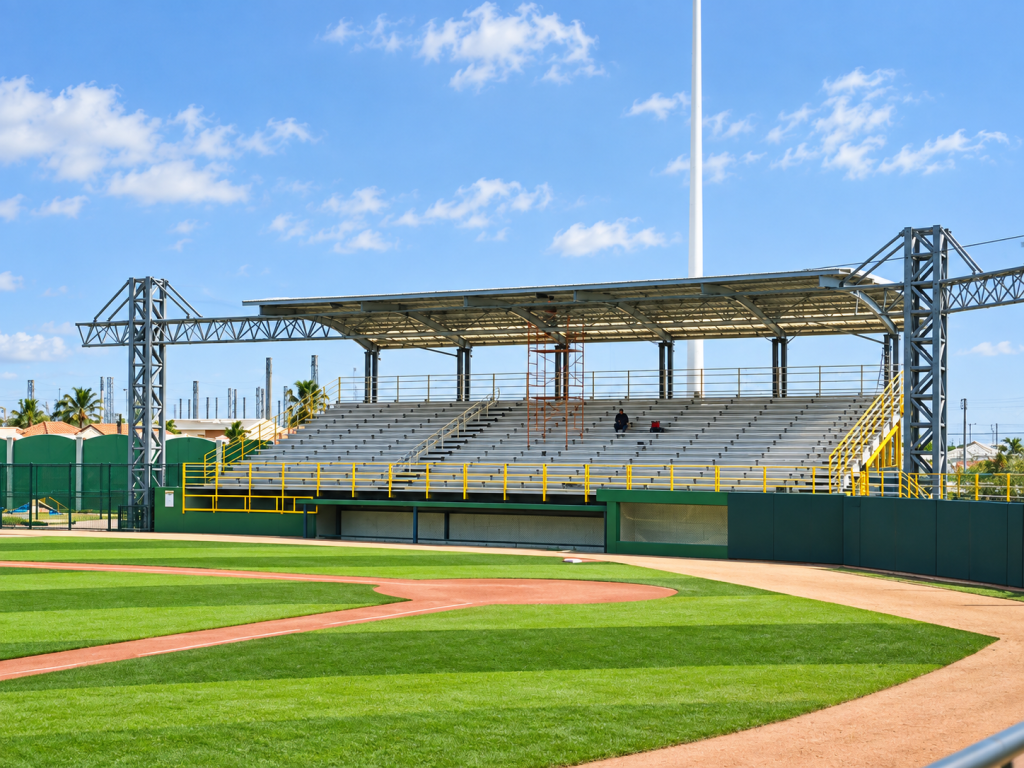
This large-span steel structure stadium project in Aruba is a distinctive international project completed by Xinguangzheng. Unlike a conventional warehouse or workshop, the stadium required a structural solution that combined large-span space, curved architectural geometry and reduced column interference near the playing field.
According to the original Xinguangzheng project records, the stadium uses a pipe truss structural system, with a listed bay spacing of 127 m and an eave height of 9.14 m. The original project summary records approximately 62.357 tons of structural steel.
The project is especially notable for its special-shaped curved steel members and the use of space truss support near the playground side, where additional columns were avoided to preserve the openness and visual quality of the space.
For international buyers evaluating a steel structure manufacturer for stadiums, sports facilities or other architecturally complex large-span buildings, this project demonstrates how Xinguangzheng can support structures that require more than a standard portal-frame solution.
Project Facts
- Manufacturer: Xinguangzheng
- Project Location: Aruba
- Building Type: Steel structure stadium
- Structural System: Pipe truss structure
- Bay Spacing: 127 m
- Eave Height: 9.14 m
- Steel Quantity: Approximately 62.357 tons according to the original project summary
- Structural Feature: Special-shaped curved steel members and space truss support
Why a Stadium Requires a Different Steel Structure Solution
A stadium or sports facility creates different structural requirements from a warehouse, factory or ordinary commercial building.
The structure may need to provide:
- large unobstructed viewing areas;
- reduced interference from columns;
- long-span roof support;
- curved or irregular architectural forms;
- coordination between structure and spectator areas;
- accurate fabrication of non-standard steel members;
- connection details suitable for complex geometry.
These requirements mean that the structural system cannot be selected only according to floor area or a standard building template.
For projects like the Aruba stadium, architectural appearance and structural behavior need to be coordinated from the early engineering stage.
Pipe Truss Structure for Large-Span Applications
The Aruba stadium uses a pipe truss structural system.
Steel trusses are commonly considered for large-span buildings because they can transfer loads through a triangulated structural arrangement while creating broad usable spaces.
Depending on the project, truss systems may be suitable for:
- stadiums;
- sports halls;
- aircraft hangars;
- exhibition buildings;
- transportation facilities;
- large industrial buildings;
- other long-span roof structures.
For Xinguangzheng, the structural system must be evaluated according to the actual span, geometry, loads, architectural requirements and project location.
The Aruba project demonstrates the use of pipe truss construction for a sports facility where visual openness and structural form are both important.
Special-Shaped Curved Steel Members
One of the most distinctive characteristics of the Aruba stadium is the use of special-shaped curved steel members.
Curved steel structures create additional challenges compared with straight structural members.
The geometry needs to be translated accurately from design information into fabrication data so that individual components can be manufactured and assembled according to the intended architectural form.
Important considerations may include:
- member geometry;
- curve accuracy;
- connection locations;
- component orientation;
- fabrication sequence;
- component identification;
- assembly relationships between adjoining members.
When a project contains irregular geometry, small dimensional deviations can affect how multiple components connect together.
This is why projects involving curved steel members place greater emphasis on engineering coordination, fabrication accuracy and drawing control.
Reducing Columns Near the Playing Field
The original Xinguangzheng project information notes that additional columns were not introduced near the playground side and that space truss beams were used as structural support.
This is an important feature for a stadium.
Columns positioned too close to spectator or activity areas can affect:
- sightlines;
- movement;
- space utilization;
- architectural appearance;
- the relationship between seating and the playing field.
Reducing structural obstructions can therefore become an important design objective.
However, removing columns also changes how structural loads need to be transferred.
The longer the unsupported distance becomes, the more important it is to coordinate structural depth, member arrangement, connections and overall stability.
Why Fabrication Accuracy Matters for Irregular Steel Structures
Standard portal-frame buildings often use repeated structural members. A stadium with curved or special-shaped steelwork can have a much higher proportion of unique components.
This changes the manufacturing challenge.
For Xinguangzheng, a project involving non-standard geometry requires careful coordination between:
- engineering information;
- shop drawings;
- component dimensions;
- fabrication;
- welding;
- component marking;
- final assembly relationships.
Accurate fabrication is particularly important when several curved or spatial members meet at one structural location.
If one component does not match the intended geometry, the problem can influence adjoining components as well.
Shop Drawings Connect the Design to Manufacturing
For complex steel structures, shop drawings are an important bridge between engineering and factory production.
They can define:
- member geometry;
- connection positions;
- steel plate details;
- welding requirements;
- component marks;
- orientation and assembly information.
This is especially important for a stadium project because special-shaped structural members cannot simply be treated as interchangeable standard parts.
Before fabrication starts, buyers and project teams should confirm that the structural and architectural information used for production is consistent.
International buyers can also review Xinguangzheng’s guide to steel building shop drawings before fabrication.
Large-Span Steel Structures Need Project-Specific Engineering
Large-span buildings are sometimes described mainly by their span, but span alone does not determine the correct structural solution.
A manufacturer also needs to understand:
- project location;
- building geometry;
- wind requirements;
- seismic requirements where applicable;
- roof configuration;
- support conditions;
- architectural requirements;
- open sides or enclosed areas;
- functional requirements below the structure.
A stadium, hangar and industrial workshop may all require large-span steel structures, but their structural solutions can be very different.
Xinguangzheng therefore evaluates large-span projects according to their actual use rather than applying one structural system to every building.
Manufacturing Non-Standard Steel Components
Projects with curved steelwork and spatial trusses require manufacturing capability beyond repetitive standard components.
The production process may involve different combinations of:
- cutting;
- forming;
- assembly;
- welding;
- dimensional verification;
- surface preparation;
- component identification.
The objective is to convert complex project geometry into steel components that can be clearly identified and assembled as part of the complete structure.
The Aruba stadium is therefore an important Xinguangzheng project reference not because of steel tonnage alone, but because of the fabrication difficulty created by its special structural form.
Component Identification for an Overseas Stadium Project
For an international steel structure project, manufacturing is only one stage.
Once components are fabricated, they also need to be identified and prepared for shipment.
This becomes particularly important when a building contains many non-standard members.
Component marking should help the project team understand how individual pieces correspond with the project drawings.
Clear organization can support:
- material identification after delivery;
- unloading planning;
- matching components with drawings;
- assembly sequencing;
- reducing confusion between similar-looking members.
Xinguangzheng’s experience with international projects means that fabrication and export preparation need to be considered as connected stages of the project process.
What Does the Aruba Stadium Demonstrate About Xinguangzheng?
The value of a real project case is that it provides evidence beyond general marketing claims.
The Aruba stadium demonstrates several aspects of Xinguangzheng’s steel structure capability:
- experience with international steel structure projects;
- experience with stadium and sports facility applications;
- pipe truss structural systems;
- large-span steel structures;
- special-shaped curved steel members;
- structures designed to reduce column interference;
- fabrication of non-standard structural geometry.
For buyers planning an architecturally complex steel building, these characteristics may be more relevant than simply asking how many tons of steel a factory can produce.
How International Buyers Should Evaluate a Large-Span Steel Structure Manufacturer
When comparing suppliers for a stadium, sports hall or another large-span structure, international buyers should evaluate more than the total quotation.
Useful questions include:
- Has the manufacturer completed similar large-span projects?
- Can the manufacturer fabricate curved or irregular steel members?
- How are shop drawings coordinated before fabrication?
- How are complex components identified?
- What structural system is proposed and why?
- What project information was used for the quotation?
- How are packing and international delivery prepared?
Real project references can help buyers determine whether the manufacturer’s past experience is relevant to the building they are planning.
You can review additional examples on the Xinguangzheng Steel Structure Projects page.
Information Needed for a New Stadium or Large-Span Project
If you are planning a stadium, sports facility or other large-span steel structure, useful information for the initial Xinguangzheng project review includes:
- Project location: country and city;
- Building use: stadium, sports hall, exhibition building or another application;
- Overall dimensions: where available;
- Required span: including areas where columns should be avoided;
- Architectural drawings: especially when the roof has curved or irregular geometry;
- Structural drawings: if already available;
- Roof requirements: including cladding or architectural requirements;
- Local design criteria: where available;
- Project supply scope: engineering, steel fabrication, envelope or other requirements.
The more clearly these requirements are defined, the easier it is to evaluate a suitable structural and manufacturing solution.
Project Value
The Aruba steel structure stadium is a useful reference for buyers looking beyond conventional steel warehouses and workshops.
According to Xinguangzheng’s original project records, the stadium uses a pipe truss structure with a listed 127 m bay spacing and 9.14 m eave height, together with special-shaped curved steel members and space truss support near the playing field.
More importantly, the project demonstrates Xinguangzheng’s experience in manufacturing steel structures where architectural geometry, long-span requirements and reduced column interference need to be considered together.
Planning a Large-Span Steel Structure Project?
If you are planning a stadium, sports facility, aircraft hangar, exhibition building or another large-span steel structure, send Xinguangzheng your project location, dimensions, required span, architectural drawings and available technical requirements.
Our team can review the available information and help evaluate a suitable steel structure solution and manufacturing scope for your project.
Discuss your project directly with Xinguangzheng:
Contact Xinguangzheng on WhatsApp
You can also visit our Contact Xinguangzheng page to send your project requirements.