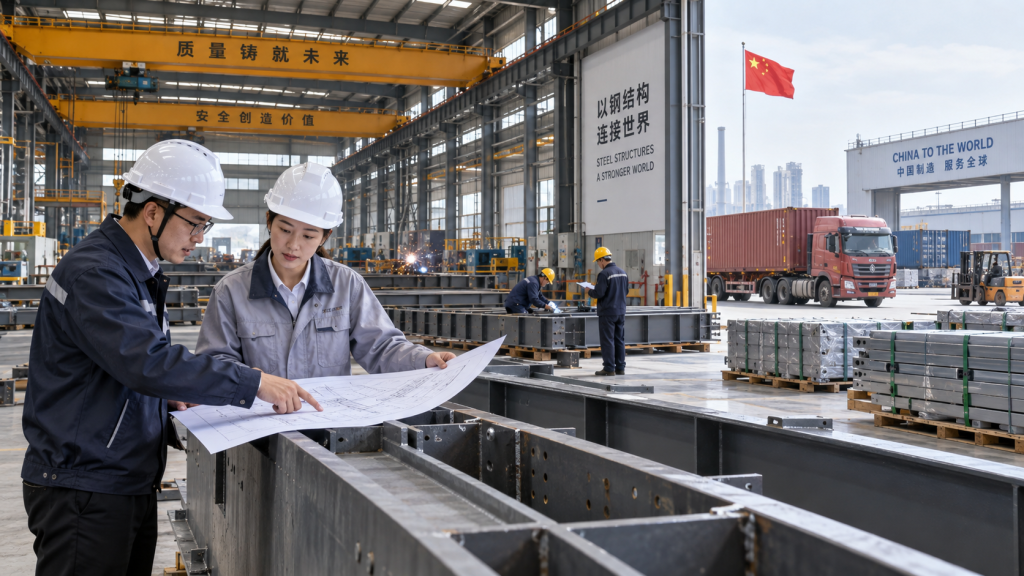
Finding a steel structure manufacturer in China is not difficult. Finding the right manufacturer for an overseas industrial project is much harder.
A search for a China steel structure manufacturer may return factories, trading companies, engineering companies, building kit suppliers, and companies specializing in very different types of steel buildings. The challenge for an international buyer is not simply finding a supplier. It is determining whether that supplier has the engineering, manufacturing, quality control, export, and project support capabilities required for the specific building.
This guide focuses on how overseas buyers can find, screen and verify steel structure manufacturers in China before creating a shortlist or requesting a final quotation.
If you already have shortlisted suppliers for an industrial plant, see our guide on how to choose a steel structure manufacturer for a factory project.
1. Start by Searching for the Type of Steel Building You Actually Need
Searching only for “steel structure manufacturer” is usually too broad.
A better approach is to combine the building application with the manufacturer or supplier intent.
For example:
- steel warehouse manufacturer China
- steel workshop manufacturer China
- prefabricated steel building manufacturer China
- industrial steel building manufacturer China
- steel hangar manufacturer China
- steel structure supplier China
This immediately reduces the number of irrelevant suppliers and helps you find manufacturers with experience in projects similar to yours.
A company experienced mainly in small agricultural sheds may not be the right supplier for a heavy industrial workshop with overhead cranes. Likewise, a supplier focused on standard building kits may not be suitable for a multi-storey industrial steel structure.
The more specific the search, the easier it becomes to identify a manufacturer whose real project experience matches your requirements.
2. Determine Whether You Are Dealing With a Manufacturer or a Trading Company
Trading companies are not automatically a problem. Some provide useful sourcing and communication services. However, for large or technically demanding steel structure projects, buyers should understand who is actually responsible for fabrication.
Ask the supplier directly:
- Where will the steel structure be manufactured?
- Who owns or operates the fabrication facility?
- Who prepares production drawings?
- Who controls welding and dimensional inspection?
- Who manages surface treatment and painting?
- Who is responsible for packing and component marking?
A reliable manufacturer should be able to explain its production process clearly rather than giving only general sales statements.
Factory photographs, production videos, fabrication records, inspection documentation, and live video calls can also help international buyers understand whether the supplier has real manufacturing capability.
3. Check Real Overseas Steel Structure Projects
One of the most useful ways to evaluate a China steel structure manufacturer is to review completed overseas projects.
Do not look only at attractive building photographs. Look for technical relevance.
Ask questions such as:
- Has the manufacturer supplied projects in other countries?
- Has it worked on buildings similar to yours?
- Has it handled large-span structures?
- Has it supplied industrial workshops with cranes?
- Has it worked on warehouses, factories, hangars, agricultural buildings, or multi-storey structures?
- Can it provide project dimensions, structural type, steel tonnage, or other verifiable project information when available?
Real projects provide stronger evidence than generic claims such as “professional manufacturer” or “high quality supplier.”
Xinguangzheng steel structure projects include different applications and international markets, such as industrial workshops, automobile facilities, aircraft hangars, hydroelectric facilities, agricultural buildings, logistics projects, and multi-storey factory structures.
Examples include an aircraft hangar project in Australia, a hydroelectric power station steel structure project in Peru, a steel structure workshop with four 5-ton overhead cranes in Thailand, a multi-storey television factory project in Algeria, and an integrated cattle farm project in Papua New Guinea.
The purpose of reviewing these cases is not simply to count how many projects a supplier has completed. It is to determine whether the manufacturer has dealt with engineering conditions comparable to your own project.
4. Evaluate Engineering Capability Before Comparing Prices
A steel building is not only a fabricated product. It is an engineered structure.
Before a reliable quotation can be prepared, the supplier needs to understand the design conditions of the project.
Important information can include:
- project location
- building length, width, and height
- building application
- wind load
- snow load where applicable
- seismic requirements
- local design standards
- roof and wall system
- crane requirements
- mezzanine or additional floor loads
- equipment loads
- openings and large doors
If a supplier provides a firm price without asking about important design conditions, buyers should understand what assumptions are being used.
Two suppliers can quote the same building dimensions but design completely different structures because they have assumed different wind loads, steel grades, column spacing, connection systems, coating specifications, or structural loads.
This is one reason the lowest initial price is not always the lowest project cost.
5. Ask How Shop Drawings and Technical Confirmations Are Managed
Before fabrication starts, the project should move from general requirements to detailed production information.
Buyers should understand the supplier’s drawing and approval process.
Questions may include:
- Who prepares the steel structure drawings?
- How are client drawings reviewed?
- When are shop drawings issued?
- How are connection details confirmed?
- How are crane beams, openings, equipment supports, and special loads coordinated?
- How are revisions controlled before fabrication?
Changing important structural requirements after fabrication begins can create additional steelwork, material waste, production delays, and site modification.
A manufacturer with a clear technical confirmation process can reduce these risks before steel enters production.
6. Compare Steel Structure Quotations Item by Item
International buyers should avoid comparing steel building quotations using only the final total price.
Instead, compare the scope behind the price.
Structural Steel
Check the proposed steel grade, estimated steel quantity, structural system, main members, secondary members, and whether special structures such as crane beams or mezzanines are included.
Roof and Wall System
Confirm whether the quotation includes single steel sheets, sandwich panels, insulation, daylighting panels, flashing, gutters, downpipes, and related accessories.
Bolts and Connections
Check whether high-strength bolts, ordinary bolts, anchor bolts, and other connection components are included.
Surface Protection
Painting or other corrosion protection requirements should be clearly defined. Coastal, humid, industrial, or corrosive environments may require different protection systems.
Doors and Windows
Some quotations include them while others exclude them.
Packing and Shipping Scope
Confirm whether export packing, component identification, container loading, inland transportation, ocean freight, and destination charges are included or excluded.
A quotation that appears cheaper may simply contain a smaller supply scope.
7. Pay Attention to Component Marking and Export Packing
This is especially important for overseas steel structure projects.
A building may contain hundreds or thousands of individual steel members, plates, bolts, purlins, bracing components, roof panels, wall panels, and accessories.
If components are poorly identified or mixed during packing, installation teams may spend unnecessary time locating the correct parts.
Before ordering, ask the manufacturer how components are:
- marked
- grouped
- packed
- protected during transportation
- matched with drawings and packing lists
Good export preparation is not as visually impressive as a completed building, but it can have a significant effect on site efficiency.
8. Evaluate Quality Control During Fabrication
Quality control should not begin only when the steel structure is ready to ship.
Buyers should ask how quality is controlled throughout fabrication.
Depending on the project requirements, relevant checks may include:
- incoming material verification
- member dimensions
- hole positioning
- welding quality
- assembly accuracy
- surface preparation
- coating thickness
- component identification
- final packing inspection
For projects with specific inspection standards or documentation requirements, these expectations should be discussed before production begins.
9. Check How the Manufacturer Communicates Before You Place an Order
Communication before the order often gives buyers useful information about what communication will be like during the project.
Pay attention to whether the supplier:
- asks technical questions rather than only discussing price
- responds clearly when drawings are involved
- identifies missing project information
- explains quotation exclusions
- confirms design assumptions
- provides structured technical responses
If important technical questions remain unanswered during the quotation stage, they may become larger problems after production starts.
10. Do Not Request Only a Price Per Square Meter
“How much is a steel building per square meter?” is one of the most common questions manufacturers receive.
It is understandable, but it is usually not enough information for a serious industrial project quotation.
Two buildings with exactly the same floor area can have very different costs because of differences in:
- span
- building height
- design loads
- steel consumption
- cranes
- mezzanines
- roof and wall systems
- corrosion protection
- doors and openings
- local engineering requirements
A more useful approach is to provide the manufacturer with basic project information and request a project-specific evaluation.
11. What Information Should You Send to a China Steel Structure Manufacturer?
If you are preparing to contact a manufacturer, the following information can help the engineering and sales teams understand your project more quickly:
- Project country and city: important for understanding local environmental and design conditions.
- Building dimensions: length, width, eave height, and other important heights.
- Building use: warehouse, workshop, factory, hangar, agricultural building, logistics facility, or another application.
- Existing drawings: architectural, structural, layout, or equipment drawings if available.
- Crane requirements: quantity, capacity, span, hook height, and operating requirements if applicable.
- Roof and wall requirements: steel sheet, insulated panel, thermal performance, or other preferences.
- Special loads or equipment: mezzanines, machinery, suspended systems, tanks, or production equipment.
- Preferred delivery schedule: useful for discussing engineering, fabrication, and shipping planning.
The more complete the initial information, the easier it is for a manufacturer to prepare a meaningful technical proposal and quotation.
12. How to Shortlist a Reliable Steel Structure Manufacturer in China
A practical shortlist should not be based on only one factor.
Before making a final decision, consider whether the supplier can demonstrate:
- real steel structure manufacturing capability
- experience with your building type
- relevant overseas project experience
- engineering and shop drawing support
- a clear quotation scope
- fabrication quality control
- export packing and component marking capability
- responsive technical communication
- project support from design confirmation through delivery
Price remains important, but it should be evaluated together with engineering scope, structural specifications, manufacturing capability, and project risk.
Looking for a Steel Structure Manufacturer in China?
Xinguangzheng provides steel structure design coordination, manufacturing, project support, and global delivery for warehouses, workshops, factories, hangars, industrial buildings, agricultural facilities, and other steel structure projects.
If you are planning a project, send us your project location, building dimensions, intended use, drawings if available, crane requirements, and other important technical information.
Our team can review the project requirements and help you evaluate a suitable steel structure solution.
Ready to discuss your project?
Discuss Your Steel Structure Project on WhatsApp
You can also review our steel structure projects to see examples of different building applications and international project experience.