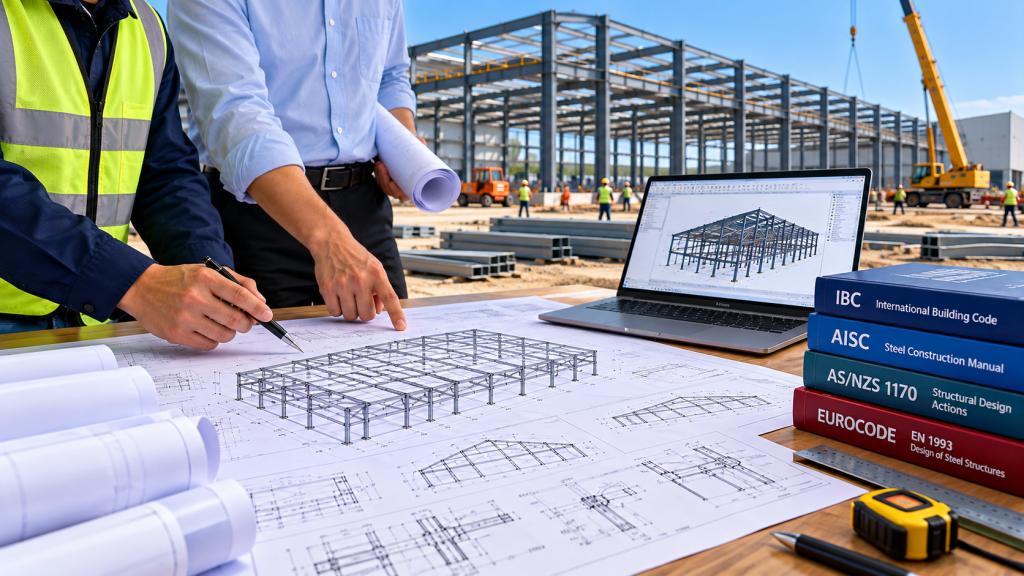
I’m Buying a Steel Building from China. Can the Manufacturer Design It to My Country’s Building Code?
If you are planning to buy a steel building from China for a project in another country, one of the most important questions is not simply the price.
It is:
“Can the Chinese steel structure manufacturer design the building according to the building code used in my country?”
For many international projects, the answer can be yes — but only when the design requirements are clearly defined before structural calculations and fabrication begin.
A steel building should not be designed according to the manufacturer’s preferred assumptions simply because it is being fabricated in China.
The structural design needs to consider the conditions and requirements of the country where the building will actually be installed.
This may include the applicable design code, wind speed, snow load, seismic conditions, building use, crane loads, roof loads and other project-specific requirements.
For buyers, the key is to clarify these requirements early and define who is responsible for structural design, review and final local approval.
Yes, a Chinese Manufacturer Can Work with Overseas Design Requirements
International steel structure manufacturers regularly work on projects located outside China.
These projects may be warehouses, factories, workshops, aircraft hangars, commercial buildings, agricultural facilities or other industrial steel buildings.
The basic steel fabrication process may take place in China, but the structural design basis should reflect the actual project location.
That means the manufacturer first needs to understand:
- Where the project will be built
- Which structural design standard should be used
- What environmental loads apply
- What the building will be used for
- Whether special equipment or cranes are involved
- Whether a local engineer must review or stamp the drawings
The earlier these points are confirmed, the easier it is to avoid redesign, quotation changes and approval delays later.
The Project Country Alone Is Not Enough
Some buyers send only the country name and building dimensions when requesting a quotation.
For example:
“I need a 100 m × 50 m × 10 m steel warehouse in Chile.”
This is useful as an initial enquiry, but it is not always enough for detailed structural design.
The manufacturer may also need the specific project city or site location because design conditions can vary significantly within the same country.
Depending on the project, important information may include:
- Basic wind speed
- Snow load
- Seismic zone
- Terrain category
- Altitude
- Exposure conditions
- Temperature range
- Building importance category
Two buildings with identical dimensions may therefore require different structural solutions if they are located in different regions.
Which Building Code Should Be Used?
Different countries and regions use different structural standards.
Some projects may reference American standards, European standards or national building codes.
For an international steel structure project, the buyer should confirm the required code before detailed design begins.
Depending on the project, the design basis may refer to standards such as:
- AISC requirements for structural steel design
- ASCE requirements for structural loads
- Eurocode structural standards
- Local national building codes
- Country-specific wind or seismic standards
The exact applicable standard should be confirmed according to the project location and approval requirements.
A manufacturer should not assume that one design standard is automatically acceptable in every country.
Wind Load Can Significantly Change the Steel Structure
Wind is one of the most important design factors for many steel buildings.
This is especially true for:
- Large warehouses
- Aircraft hangars
- High industrial buildings
- Buildings in coastal regions
- Buildings in cyclone or hurricane-prone areas
Wind load can affect:
- Column sizes
- Rafter sizes
- Bracing systems
- Connections
- Anchor bolts
- Purlins and girts
- Roof and wall cladding systems
This is why a quotation based on an incorrect wind assumption may later change significantly when the real local design conditions are confirmed.
For buyers, it is better to provide the required wind data before comparing final quotations.
Snow Load Must Be Confirmed Where Applicable
For projects in colder climates, snow load can also have a major influence on the structural design.
The roof structure must be designed for the required loading conditions rather than only the dead weight of the roofing system.
Snow load can affect:
- Rafter sections
- Column sections
- Roof purlins
- Bracing
- Connection design
If one supplier calculates the building using a significant snow load while another assumes almost no snow, their steel quantities and prices may be very different.
That does not automatically mean one supplier is expensive and the other is cheaper.
They may simply be designing two different structures.
Seismic Requirements Can Also Affect the Design
For projects in seismic regions, earthquake design requirements should be confirmed before the structural system is finalized.
The seismic design basis may influence:
- Structural system selection
- Member sizes
- Bracing arrangement
- Connection details
- Foundation reactions
Buyers should therefore provide the applicable seismic parameters or local design requirements whenever available.
If these parameters are not available at the quotation stage, the manufacturer should clearly state which assumptions have been used.
Building Use Matters Too
The local building code is only one part of the design basis.
The manufacturer also needs to understand how the steel building will be used.
A warehouse, production factory, aircraft hangar and livestock building can have very different design requirements.
For example, an industrial factory may require:
- Overhead cranes
- Mezzanines
- Equipment platforms
- Heavy roof equipment
- Special openings
- Future expansion
An aircraft hangar may require a large clear span and large hangar doors.
A warehouse may prioritize storage height, pallet racking and loading access.
The structural design should therefore be based on both local code requirements and the real operating requirements of the building.
What if My Factory Needs an Overhead Crane?
If the building requires an overhead crane, this information should be provided before the steel structure is finalized.
The manufacturer may need:
- Crane capacity
- Number of cranes
- Crane span
- Hook height
- Crane runway elevation
- Operating classification
- Whether multiple cranes may operate simultaneously
Crane loads can have a significant effect on the columns, crane beams, brackets and foundations.
Adding a crane after the main building has already been designed can require substantial structural changes.
Can the Chinese Manufacturer Prepare the Structural Calculations?
This depends on the manufacturer and the project scope.
For some projects, the Chinese manufacturer develops the structural scheme and prepares calculations and drawings based on the agreed design criteria.
For other projects, the buyer already has structural drawings prepared by a local engineering company, and the Chinese supplier mainly reviews the fabrication requirements and manufactures according to the approved drawings.
There are also projects where both parties work together:
- The Chinese manufacturer develops the preliminary structural design
- The buyer’s local engineer reviews it
- Comments are returned
- The design is revised
- The final version is approved before fabrication
The most important point is not which model is used.
The important point is that the responsibility should be clearly defined before the order is placed.
Does the Manufacturer’s Drawing Automatically Mean Local Approval?
No.
This is a very important distinction for international buyers.
A manufacturer may be able to prepare structural calculations and drawings according to the requested design standard, but that does not automatically mean those documents satisfy every local administrative approval requirement.
Depending on the country or project, local authorities may require:
- Review by a locally licensed engineer
- Local engineer signature or stamp
- Submission through a local consultant
- Local authority approval
- Additional fire, architectural or civil documentation
These requirements vary by jurisdiction.
For this reason, buyers should confirm the approval procedure with their local engineer, contractor or relevant authority before fabrication begins.
A Good Cooperation Model: Chinese Manufacturer + Local Engineer
For many overseas projects, one practical approach is cooperation between the steel structure manufacturer and a local engineer.
The manufacturer understands steel structure design, fabrication, connection details and production requirements.
The local engineer understands the local building code, approval procedure, foundation conditions and authority requirements.
When both sides exchange technical information early, many problems can be solved before the steel is fabricated.
A typical workflow may be:
- Buyer provides architectural drawings and project requirements
- Local design criteria are confirmed
- Steel structure manufacturer develops the structural proposal
- Local engineer reviews the proposal
- Design comments are incorporated
- Structural drawings are confirmed
- Fabrication drawings are prepared
- Fabrication begins after approval
This process can be especially useful when the buyer wants Chinese manufacturing capability while still meeting local engineering and approval requirements.
What Information Should You Send Before Asking for a Quote?
If you want the manufacturer to consider your local building code from the beginning, provide as much design information as possible during the quotation stage.
Useful information may include:
- Project country
- Project city or exact site location
- Building use
- Building length, width and height
- Required clear span
- Required design code
- Wind speed or wind pressure
- Snow load where applicable
- Seismic requirements
- Roof live load
- Mezzanine loads
- Crane information
- Roof and wall specifications
- Architectural drawings
- Existing structural drawings if available
If some information is not yet available, tell the manufacturer clearly instead of allowing unknown conditions to be treated as confirmed values.
You can also review our guide on what information to prepare before requesting a steel structure quotation.
What if I Already Have Drawings from My Local Engineer?
If your local engineer has already prepared architectural or structural drawings, those documents can provide a strong basis for quotation.
The Chinese manufacturer can review the available drawings and determine whether they contain enough information for preliminary or detailed pricing.
The buyer should clarify whether the manufacturer is expected to:
- Manufacture strictly according to the existing design
- Review the design for fabrication
- Optimize some structural details
- Prepare shop drawings
- Develop a new structural proposal
If you already have factory drawings, see our guide:
I Already Have Factory Drawings. Can a Chinese Steel Structure Manufacturer Quote Directly?
Why Quotes Can Change After the Local Code Is Confirmed
This is another point buyers should understand before comparing steel building prices.
Suppose a manufacturer provides an early quotation based on preliminary assumptions.
Later, the buyer confirms that the project requires:
- Higher wind load
- Additional seismic requirements
- Higher roof load
- Overhead cranes
- Different steel grades
The structural design may then require larger members, additional bracing or different connections.
Steel quantity and project cost may increase.
This is not necessarily a price change without reason.
It may be the result of the design basis becoming more accurate.
For this reason, buyers should compare quotations using the same structural design criteria.
Do Not Compare Suppliers Using Only Price per Square Meter
A price per square meter can be useful for early budgeting, but it is not enough for evaluating a final steel structure quotation.
Two suppliers may quote the same 5,000 m² building at very different prices because they are using different:
- Wind loads
- Snow loads
- Seismic parameters
- Steel grades
- Column spacing
- Member sizes
- Roof systems
- Wall systems
- Surface treatments
- Supply scopes
Before deciding which quotation is competitive, confirm that the technical basis is comparable.
Ask These Questions Before Choosing a Chinese Manufacturer
If local building code compliance is important for your project, ask potential suppliers directly:
- Can you design according to the required structural standard?
- What information do you need from my local engineer?
- Which wind, snow and seismic parameters are used in your quotation?
- Can you provide structural calculations?
- Can you coordinate drawing revisions with my local engineer?
- Who prepares the shop drawings?
- At what stage does fabrication begin?
- What happens if the local engineer requests design changes?
- Which parts of the local approval process are outside your supply scope?
The supplier’s answers can tell you more than simply asking for the lowest price.
How Xinguangzheng Supports Overseas Steel Structure Projects
Qingdao Xinguangzheng Steel Structure Co., Ltd. works with international project owners, contractors and industrial buyers on steel structure warehouses, factories, workshops, hangars and other buildings.
For overseas projects, the first step is to understand the project location, building use, available drawings, design requirements and expected supply scope.
If local design conditions or drawings are already available, they can be reviewed as part of the project discussion.
If the project is still at an early stage, the required information and design assumptions should be clarified before the quotation is treated as a final project price.
You can view Xinguangzheng steel structure projects from different countries and building applications.
Buying a Steel Building from China? Confirm the Design Basis First
Buying a steel building from China can provide access to engineering, fabrication and international project supply capabilities, but the project should be designed for where it will actually be built.
Before comparing final quotations, confirm:
- Applicable structural design code
- Project location
- Wind load
- Snow load
- Seismic requirements
- Building use
- Crane and equipment loads
- Local engineering approval requirements
This helps both buyer and manufacturer work from the same technical basis and reduces the risk of redesign after the project has already moved into fabrication.
If you are planning an overseas steel structure project and already have architectural drawings, structural requirements or local design criteria, contact Xinguangzheng and send the available project information for review.